Before installing Hadoop into the Linux environment, we need to set up
Linux using ssh (Secure Shell). Follow the steps given below for setting
up the Linux environment.
Wednesday, 27 January 2016

Hadoop - Enviornment Setup
Hadoop is supported by GNU/Linux platform and its flavors. Therefore, we
have to install a Linux operating system for setting up Hadoop
environment. In case you have an OS other than Linux, you can install a
Virtualbox software in it and have Linux inside the Virtualbox.
Pre-installation Setup
Creating a User
SSH Setup and Key Generation
Installing Java
Downloading Hadoop
Hadoop Operation Modes
Verifying Hadoop Installation
Thursday, 31 December 2015
Advantages of Hadoop
Advantages of Hadoop
- Hadoop framework allows the user to quickly write and test distributed systems. It is efficient, and it automatic distributes the data and work across the machines and in turn, utilizes the underlying parallelism of the CPU cores.
- Hadoop does not rely on hardware to provide fault-tolerance and high availability (FTHA), rather Hadoop library itself has been designed to detect and handle failures at the application layer.
- Servers can be added or removed from the cluster dynamically and Hadoop continues to operate without interruption.
- Another big advantage of Hadoop is that apart from being open source, it is compatible on all the platforms since it is Java based.
How Does Hadoop Work?
Stage 1
A user/application can submit a job to the Hadoop (a hadoop job client) for required process by specifying the following items:- The location of the input and output files in the distributed file system.
- The java classes in the form of jar file containing the implementation of map and reduce functions.
- The job configuration by setting different parameters specific to the job.
Stage 2
The Hadoop job client then submits the job (jar/executable etc) and configuration to the JobTracker which then assumes the responsibility of distributing the software/configuration to the slaves, scheduling tasks and monitoring them, providing status and diagnostic information to the job-client.Stage 3
The TaskTrackers on different nodes execute the task as per MapReduce implementation and output of the reduce function is stored into the output files on the file system.Hadoop Distributed File System
Hadoop can work directly with any mountable distributed file system such as Local FS, HFTP FS, S3 FS, and others, but the most common file system used by Hadoop is the Hadoop Distributed File System (HDFS).
The Hadoop Distributed File System (HDFS) is based on the Google File System (GFS) and provides a distributed file system that is designed to run on large clusters (thousands of computers) of small computer machines in a reliable, fault-tolerant manner.
HDFS uses a master/slave architecture where master consists of a single NameNode that manages the file system metadata and one or more slave DataNodes that store the actual data.
A file in an HDFS namespace is split into several blocks and those blocks are stored in a set of DataNodes. The NameNode determines the mapping of blocks to the DataNodes. The DataNodes takes care of read and write operation with the file system. They also take care of block creation, deletion and replication based on instruction given by NameNode.
HDFS provides a shell like any other file system and a list of commands are available to interact with the file system. These shell commands will be covered in a separate chapter along with appropriate examples.
MapReduce
Hadoop MapReduce is a software framework for easily writing applications which process big amounts of data in-parallel on large clusters (thousands of nodes) of commodity hardware in a reliable, fault-tolerant manner.
The term MapReduce actually refers to the following two different tasks that Hadoop programs perform:
- The Map Task: This is the first task, which takes input data and converts it into a set of data, where individual elements are broken down into tuples (key/value pairs).
- The Reduce Task: This task takes the output from a map task as input and combines those data tuples into a smaller set of tuples. The reduce task is always performed after the map task.
The MapReduce framework consists of a single master JobTracker and one slave TaskTracker
per cluster-node. The master is responsible for resource management,
tracking resource consumption/availability and scheduling the jobs
component tasks on the slaves, monitoring them and re-executing the
failed tasks. The slaves TaskTracker execute the tasks as directed by
the master and provide task-status information to the master
periodically.
The JobTracker is a single point of failure for the Hadoop MapReduce
service which means if JobTracker goes down, all running jobs are
halted.
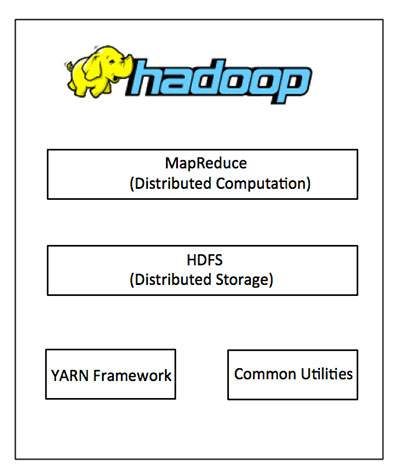
Hadoop Architecture
Hadoop framework includes following four modules:
- Hadoop Common: These are Java libraries and utilities required by other Hadoop modules. These libraries provides filesystem and OS level abstractions and contains the necessary Java files and scripts required to start Hadoop.
- Hadoop YARN: This is a framework for job scheduling and cluster resource management.
- Hadoop Distributed File System (HDFS™): A distributed file system that provides high-throughput access to application data.
- Hadoop MapReduce: This is YARN-based system for parallel processing of large data sets.
MapReduce
Hadoop Distributed File System
Subscribe to:
Posts (Atom)