Pages

Thursday, 4 August 2016

Mapreduce Program

Example Program

Given below is the program to the sample data using MapReduce framework.


package hadoop; 
import java.util.*; 
import java.io.IOException; 

import org.apache.hadoop.fs.Path; 
import org.apache.hadoop.conf.*; 
import org.apache.hadoop.io.*; 
import org.apache.hadoop.mapred.*; 
import org.apache.hadoop.util.*; 

public class ProcessUnits 
{ 
   //Mapper class 
   public static class E_EMapper extends MapReduceBase implements 
   Mapper<LongWritable ,/*Input key Type */ 
   Text,                /*Input value Type*/ 
   Text,                /*Output key Type*/ 
   IntWritable>        /*Output value Type*/ 
   { 
      
      //Map function 
      public void map(LongWritable key, Text value, 
      OutputCollector<Text, IntWritable> output,   
      Reporter reporter) throws IOException 
      { 
         String line = value.toString(); 
         String lasttoken = null; 
         StringTokenizer s = new StringTokenizer(line,"\t"); 
         String year = s.nextToken(); 
         
         while(s.hasMoreTokens())
            {
               lasttoken=s.nextToken();
            } 
            
         int avgprice = Integer.parseInt(lasttoken); 
         output.collect(new Text(year), new IntWritable(avgprice)); 
      } 
   } 
   
   
   //Reducer class 
   public static class E_EReduce extends MapReduceBase implements 
   Reducer< Text, IntWritable, Text, IntWritable > 
   {  
   
      //Reduce function 
      public void reduce( Text key, Iterator <IntWritable> values, 
         OutputCollector<Text, IntWritable> output, Reporter reporter) throws IOException 
         { 
            int maxavg=30; 
            int val=Integer.MIN_VALUE; 
            
            while (values.hasNext()) 
            { 
               if((val=values.next().get())>maxavg) 
               { 
                  output.collect(key, new IntWritable(val)); 
               } 
            } 
 
         } 
   }  
   
   
   //Main function 
   public static void main(String args[])throws Exception 
   { 
      JobConf conf = new JobConf(ProcessUnits.class); 
      
      conf.setJobName("max_eletricityunits"); 
      conf.setOutputKeyClass(Text.class);
      conf.setOutputValueClass(IntWritable.class); 
      conf.setMapperClass(E_EMapper.class); 
      conf.setCombinerClass(E_EReduce.class); 
      conf.setReducerClass(E_EReduce.class); 
      conf.setInputFormat(TextInputFormat.class); 
      conf.setOutputFormat(TextOutputFormat.class); 
      
      FileInputFormat.setInputPaths(conf, new Path(args[0])); 
      FileOutputFormat.setOutputPath(conf, new Path(args[1])); 
      
      JobClient.runJob(conf); 
   } 
} 
 
 
Save the above program as ProcessUnits.java. 

Input Data

Input Data

The above data is saved as sample.txtand given as input. The input file looks as shown below.

1979   23   23   2   43   24   25   26   26   26   26   25   26  25 
1980   26   27   28  28   28   30   31   31   31   30   30   30  29 
1981   31   32   32  32   33   34   35   36   36   34   34   34  34 
1984   39   38   39  39   39   41   42   43   40   39   38   38  40 
1985   38   39   39  39   39   41   41   41   00   40   39   39  45 

Answer for Map Reduce -- Example Scenario

Map Reduce -- Example Scenario

Given below is the data regarding the electrical consumption of an organization. It contains the monthly electrical consumption and the annual average for various years.


Jan
Feb
Mar
Apr
May
Jun
Jul
Aug
Sep
Oct
Nov
Dec
Avg
1979
23
23
2
43
24
25
26
26
26
26
25
26
25
1980
26
27
28
28
28
30
31
31
31
30
30
30
29
1981
31
32
32
32
33
34
35
36
36
34
34
34
34
1984
39
38
39
39
39
41
42
43
40
39
38
38
40
1985
38
39
39
39
39
41
41
41
00
40
39
39
45

Click Here for
Answer

MapReduce Terminology

Terminology

  • PayLoad - Applications implement the Map and the Reduce functions, and form the core of the job.
  • Mapper - Mapper maps the input key/value pairs to a set of intermediate key/value pair.
  • NamedNode - Node that manages the Hadoop Distributed File System (HDFS).
  • DataNode - Node where data is presented in advance before any processing takes place.
  • MasterNode - Node where JobTracker runs and which accepts job requests from clients.
  • SlaveNode - Node where Map and Reduce program runs.
  • JobTracker - Schedules jobs and tracks the assign jobs to Task tracker.
  • Task Tracker - Tracks the task and reports status to JobTracker.
  • Job - A program is an execution of a Mapper and Reducer across a dataset.
  • Task - An execution of a Mapper or a Reducer on a slice of data.
  • Task Attempt - A particular instance of an attempt to execute a task on a SlaveNode.

MapReduce Algorithm

MapReduce Algorithm

  • Generally MapReduce paradigm is based on sending the computer to where the data resides!
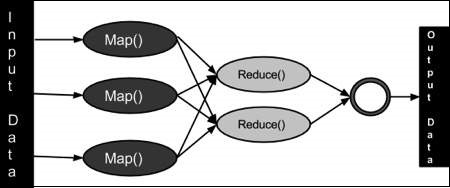
  • MapReduce program executes in three stages, namely map stage, shuffle stage, and reduce stage.
    • Map stage : The map or mapper’s job is to process the input data. Generally the input data is in the form of file or directory and is stored in the Hadoop file system (HDFS). The input file is passed to the mapper function line by line. The mapper processes the data and creates several small chunks of data.
    • Reduce stage : This stage is the combination of the Shuffle stage and the Reduce stage. The Reducer’s job is to process the data that comes from the mapper. After processing, it produces a new set of output, which will be stored in the HDFS.
  • During a MapReduce job, Hadoop sends the Map and Reduce tasks to the appropriate servers in the cluster.
  • The framework manages all the details of data-passing such as issuing tasks, verifying task completion, and copying data around the cluster between the nodes.
  • Most of the computing takes place on nodes with data on local disks that reduces the network traffic.
  • After completion of the given tasks, the cluster collects and reduces the data to form an appropriate result, and sends it back to the Hadoop server.
MapReduce Algorithm

Inputs and Outputs (Java Perspective)

The MapReduce framework operates on <key, value> pairs, that is, the framework views the input to the job as a set of <key, value> pairs and produces a set of <key, value> pairs as the output of the job, conceivably of different types.
The key and the value classes should be in serialized manner by the framework and hence, need to implement the Writable interface. Additionally, the key classes have to implement the Writable-Comparable interface to facilitate sorting by the framework. Input and Output types of a MapReduce job: (Input) <k1, v1> -> map -> <k2, v2>-> reduce -> <k3, v3>(Output).

Input Output
Map <k1, v1> list (<k2, v2>)
Reduce <k2, list(v2)> list (<k3, v3>)

What is MapReduce?

MapReduce is a processing technique and a program model for distributed computing based on java. The MapReduce algorithm contains two important tasks, namely Map and Reduce. Map takes a set of data and converts it into another set of data, where individual elements are broken down into tuples (key/value pairs). Secondly, reduce task, which takes the output from a map as an input and combines those data tuples into a smaller set of tuples. As the sequence of the name MapReduce implies, the reduce task is always performed after the map job.

The major advantage of MapReduce is that it is easy to scale data processing over multiple computing nodes. Under the MapReduce model, the data processing primitives are called mappers and reducers. Decomposing a data processing application into mappers and reducers is sometimes nontrivial. But, once we write an application in the MapReduce form, scaling the application to run over hundreds, thousands, or even tens of thousands of machines in a cluster is merely a configuration change. This simple scalability is what has attracted many programmers to use the MapReduce model.